Your health cannot keep waiting for work to become quieter.
It cannot keep waiting for the children to need you less, the pressure to ease, or the perfect Monday when you finally feel motivated.
That time may never arrive.
Meanwhile, you become a little weaker. Your waistline increases. Your fitness declines. Your sleep becomes more disrupted, and you gradually lose confidence in what your body can do.
This rarely happens because you do not understand the importance of your health.
It happens because your health has become the easiest part of your life to sacrifice.
You remain dependable at work. You meet the needs of your family. You deal with problems, responsibilities and deadlines.
To everyone else, you still appear capable and successful.
But privately, you know your physical health no longer reflects the person you want to be.
Tom could easily have continued along that path.
He is 57, has four daughters and runs his own business. When we first met, he wanted to lose body fat, reduce his waistline, improve his running, eat better, feel more energetic and see whether improving his health could help with his sleep apnoea symptoms.
After only two months, Tom has:
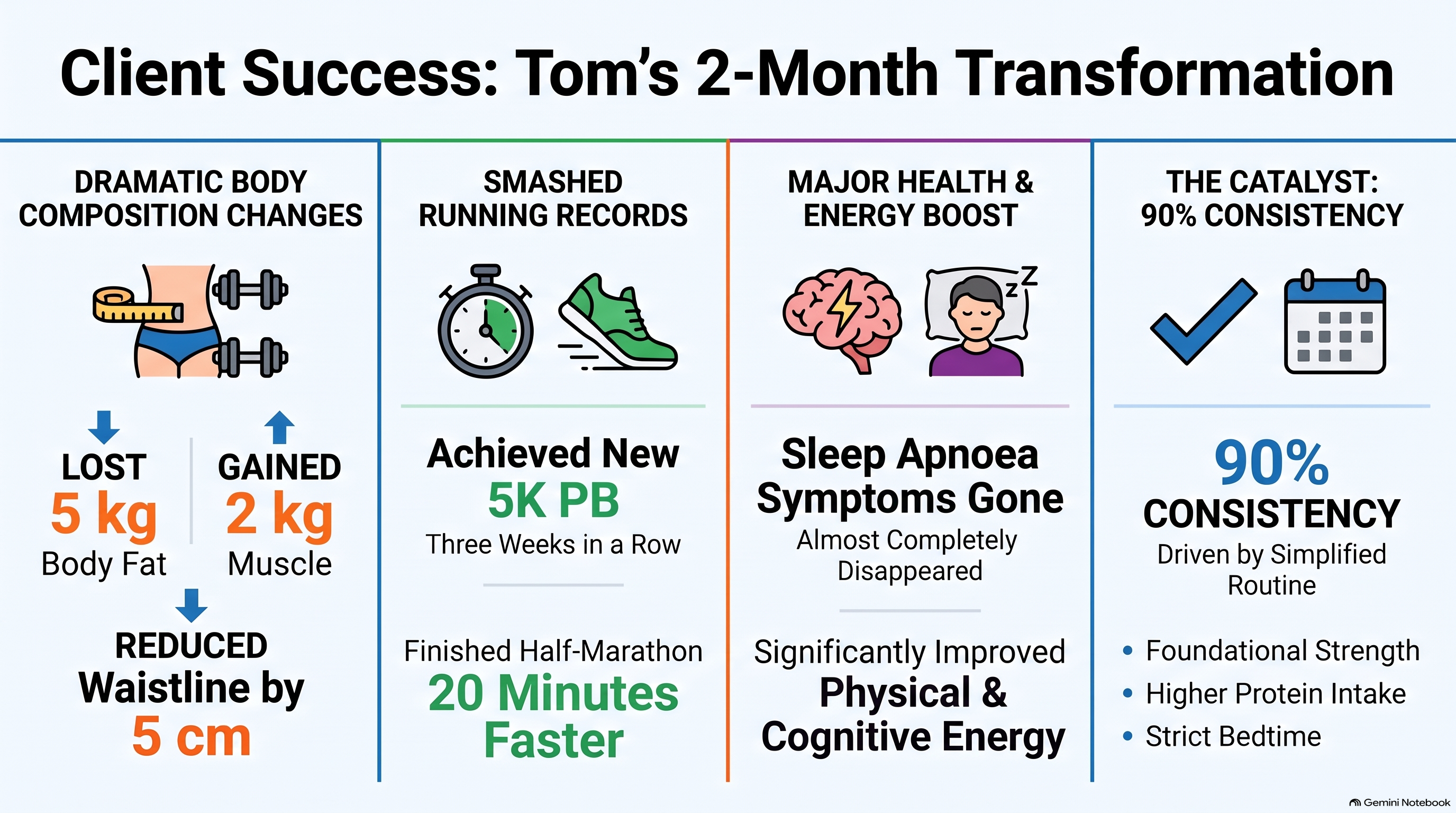
• Lost 5 kg of body fat
• Gained 2 kg of muscle
• Reduced his waistline by 5 cm
• Achieved a new 5K personal best three weeks in a row
• Completed a half-marathon 20 minutes faster
• Improved his physical and cognitive energy
• Reported that his sleep apnoea symptoms have almost completely disappeared
• Maintained more than 90% consistency with his habits
But the most important result is not the weight he has lost, the muscle he has gained or how much faster he can run.
Tom now believes he can change his health.
The Real Problem Was Not A Lack Of Knowledge
Most people over 50 already know that they should exercise, eat better, consume enough protein and protect their sleep.
Knowing is rarely the problem.
The problem is continuing to take those actions when you are tired, busy, stressed or surrounded by competing demands.
A plan that only works when life is easy is not a useful plan.
Tom did not need another collection of health information. He needed a clear structure that helped him turn what he knew into repeated action.
His plan was deliberately simple and designed specifically for him.
It included foundational strength training, a much higher protein intake, a simplified approach to food, a consistent bedtime and continued running.
Every morning, Tom sent me his action plan. Every evening, he reviewed what he had completed.
The individual actions were not revolutionary.
The difference was that Tom followed them with more than 90% consistency.
WISDOM In Action
Tom’s progress demonstrates the six pillars of my WISDOM coaching framework.
Willingness
Tom was willing to experience some discomfort.
He trained when it would have been easier not to. He changed familiar eating habits, protected his bedtime and reported honestly on what he had and had not completed.
Willingness does not mean enjoying every part of the process. It means deciding that the outcome matters enough to do what is required.
Identity
Every completed workout and useful food choice gave Tom another piece of evidence about who he was becoming.
He was no longer someone hoping to improve his health.
He was becoming someone who trained, planned, followed through and took responsibility for his physical future.
Simple
We did not attempt to change everything at once.
The plan concentrated on clear actions Tom could understand and repeat. This reduced the number of decisions he needed to make during an already demanding day.
Simple does not mean easy. It means removing unnecessary complexity so that you can concentrate on taking action.
Design
Tom did not leave his health to chance.
His morning plan established what he would do. His evening review created accountability. His regular bedtime supported his sleep and recovery.
Instead of hoping that the right actions would happen, we designed his day to make them more likely.
Overcome
Running a business and raising a family do not suddenly become easier because you have started a health programme.
There will still be pressure, tiredness, disrupted plans and difficult days.
Tom’s progress did not depend on everything going smoothly. It came from learning to take the next useful action when conditions were imperfect.
Mindset
Tom now has evidence that his health can improve at 57.
That evidence has changed what he believes is possible.
He is not simply hoping that he can become leaner, stronger and fitter. He has demonstrated to himself that his actions can make it happen.
What Happens If Nothing Changes?
This is the question many people avoid.
What will your physical health look like in five years if you continue treating it as negotiable?
Will you still be able to run, travel, play with your grandchildren and enjoy everything you have worked to create?
Or will you arrive at retirement professionally successful but without the strength, fitness and confidence to enjoy it fully?
These are uncomfortable questions, but avoiding them does not remove the consequences.
The encouraging part of Tom’s story is that decline is not the only possible direction.
In eight weeks, he has become leaner, stronger, faster and more energetic. More importantly, he is developing a way of living that can protect his health for years to come.
Tom’s results are individual to him and cannot be guaranteed for anyone else. His reported improvement in sleep apnoea symptoms should also be discussed with an appropriate medical professional.
But the underlying lesson applies to all of us.
You probably already know much of what you should be doing.
The question is whether your current structure helps you do it consistently.
What could change over the next two months if your health stopped being negotiable?
Your Next Step
If you are over 50 and know what you should be doing but struggle to do it consistently, the CapabilitySpan Assessment can help identify where your health needs the most support.
Ask yourself:
What is preventing me from taking the action that matters, and what is the simplest useful change I can test next?
Take the same journey as Tom did by first taking the Health & Capability Assessment and using your results to decide what needs to change first.
- Willingness
- Identity
- Simple
- Overcoming Obstacles
- Design
- Mindset